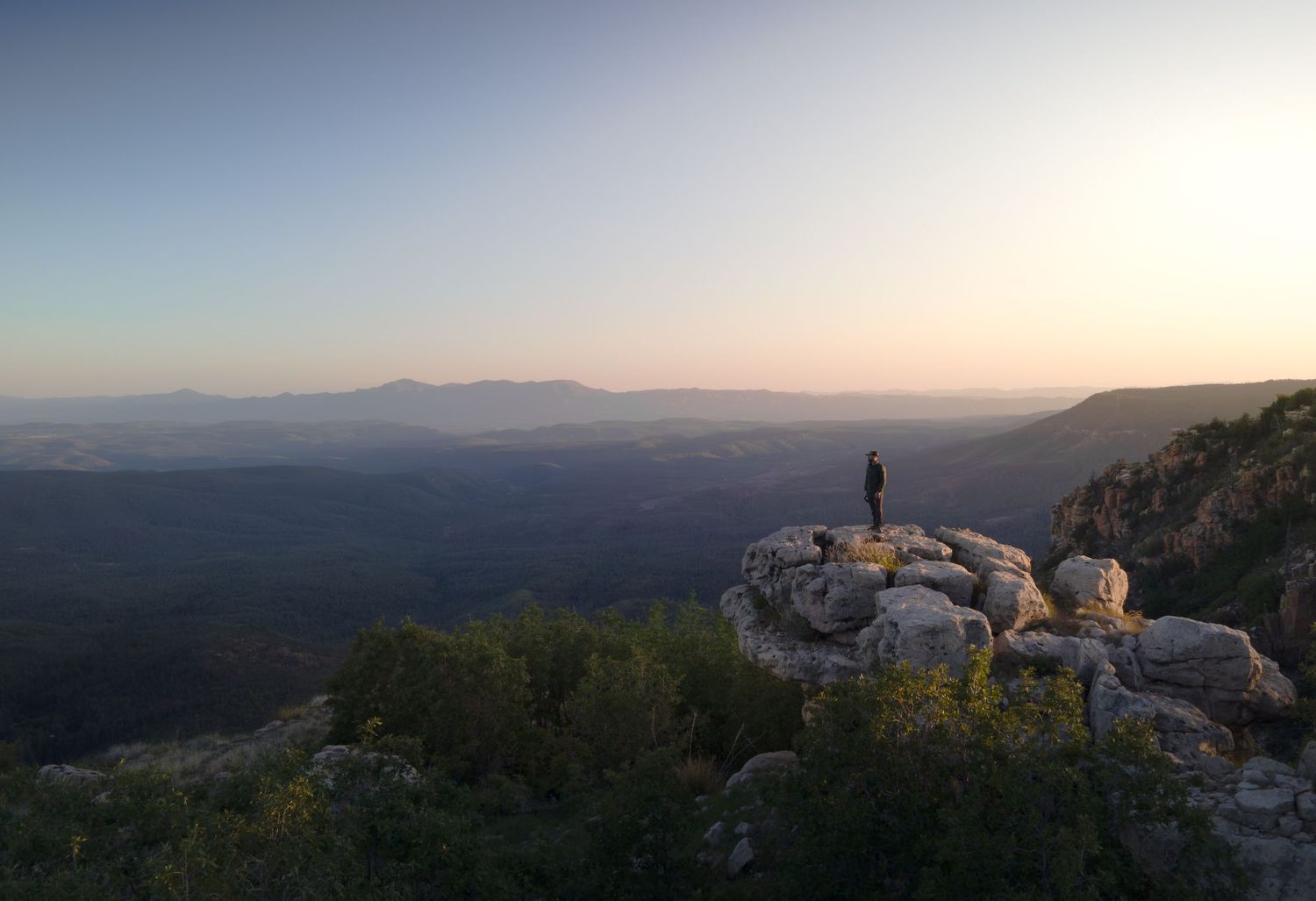
A self portrait (drone) on top of the Mogollon Rim in Arizona.
The Mogollon Rim
Upon leaving Flagstaff I pointed my van east, towards the Mogollon Rim. Like many of you, I imagine, I had never heard of it before, but after a friend mentioned it in conversation, I kept hearing murmurings of it from locals and other travelers. And that was enough for me—I decided to check it out for myself.
The Mogollon Rim is the point in which the Colorado Plateau drops off sharply to the lower-elevation hills below. While the hills themselves generally sit at a respectable 4-5k feet in elevation, much of the Mogollon Rim is perched at around 7-8k feet. The sudden shift in elevation makes for a special sight.
Most of the land along the Mogollon Rim is National Forest Land, which means that, unless otherwise stated, adventurers like me can camp, for free, anywhere along the 40 miles of dirt road lining the rim. Hearing this, I made sure to load up on food and water just in case I decided to stay for a while.
When I finally arrived, I found a great site for the night, right next to the rim, and began exploring my local area. I love to scramble around on big rocks and, as I was doing so atop the rim, it was clear to me that I was climbing over a different type of rock than I am accustomed to. While the cliffs themselves are mostly red in color and are said to be made of limestone or sandstone, this upper layer I was scrambling on was oddly textured, extra grippy under foot, and was nearly white.
As I paused my scrambling to take a closer look at this strange rock, I noticed that, embedded in the rock, were seashells and fossilized imprints of small sea creatures. And it sort of blew my mind. Here I am, on top of The Mogollon Rim in Arizona, over 7,000 feet above sea level, and it’s littered with evidence of sea life. Mollusks, ammonites, corals and crinoids, all perfectly preserved in the stone. And the strange rocks I was scrambling across... those turned out to be ancient coral reef—violently thrust upwards from the sea bed ages and ages ago.
I couldn’t help but do a bunch of research since my discovery, and apparently the presence of coral reef, along with the specific types of fossils present, are some of the indications that scientists have used to determine that this area used to be a relatively shallow, warm, tropical ocean, teeming with the types of sea life that’s simply not found in colder, deeper oceans. In fact, I later learned that much of the small stones and gravel on top of the rim and alongside the roads are made up of fragments of ancient brachiopod shells that have been crushed up by nature over the past few millions of years.
Arizona was once a thriving tropical ocean—what a trip!
I ended up staying a total of three nights atop the rim—completely in awe of its beauty and its history. I initially planned to spend a week or more up there, exploring the different camp sites and viewpoints along the rim. In fact, when I arrived I hardly saw anyone else and I figured I’d pretty much get my choice of campsite throughout the week. However, since I’ve barely even glanced at a calendar since hitting the road, I wasn’t aware that my plans accidentally overlapped with Memorial Day weekend, which ended up bringing hoards of dirt bikes, ATV’s, trucks and other campers to the rim—not quite the calm, nature environment I was looking for. So, after a lovely three days at my quiet little overlook spot, I decided to cut my visit short and backtracked to the main road instead of continuing along the rim like I initially planned.
Even though it didn’t last as long as I expected, the three nights I did spend at The Mogollon Rim were lovely, and it’s an area that, even if I never return, will hold a very special place in my memory.
“Stretching out over more than 200 miles from Yavapai County to New Mexico is the Mogollon Rim. With its expansive, breathtaking views, the Rim serves to inspire nothing less than shock and awe. It’s truly a geological masterpiece made up of sedimentary, volcanic and metamorphic rock, dating back to what scientists call the Precambrian Era. Row after row of silhouetted, blue mountains stretch out towards the horizon to meet the sky. With the exception of the Grand Canyon, no other physical feature of Arizona’s landscape is more prominent than the Mogollon Rim.” –azpbs.org
P.S. If I’m not mistaken, this photo is the only self-portrait I’ve ever shared on Photo of the Week. It was taken at sunset, on top of The Mogollon Rim, with the aid of my drone (which was particularly fun to fly along the rim). In fact, those rocks I’m standing on? Those are some of the coral reef I mentioned earlier. This spot was a short walk from where I camped for three days, and ended up being my favorite place to watch the sunset. If you’re ever in the area, I highly recommend that you go and check out The Mogollon Rim for yourself.
Thank you for reading!
If so inclined, below are a few ways to help support me and my art:
Subscribe
Print Shop